
Article Plan: “I Survived the Battle of Gettysburg” ー Eyewitness Accounts & Historical Context
Exploring digitized primary sources, like those from the Gettysburg Compiler, reveals compelling “I Survived” narratives. Numerous PDFs contain firsthand accounts, offering intimate perspectives.
The immediacy of “I Survived” accounts transcends historical distance, forging a powerful connection between readers and the past. These narratives, often found within digitized collections and accessible as PDFs, offer a uniquely human dimension to the grand sweep of events like the Battle of Gettysburg. Unlike strategic overviews, these personal testimonies detail the visceral experience of conflict – the fear, the chaos, and the enduring psychological impact.
Documents like Catherine Mary White Foster’s report, initially published in the Gettysburg Compiler, and Tillie Pierce’s seminary girl’s perspective, exemplify this power. Compilations featuring accounts from Lee, Longstreet, Meade, and Hancock further enrich our understanding. The availability of these primary sources, often previously unpublished, allows for a deeper, more nuanced appreciation of Gettysburg’s human cost, moving beyond statistics to individual stories of survival.
The Search for “I Survived the Battle of Gettysburg” ー PDF & Primary Sources
Locating authentic “I Survived” accounts often begins with exploring online archives and digital libraries. Numerous PDFs compile firsthand experiences from Gettysburg, including those of soldiers and civilians. The Gettysburg Compiler, a crucial local resource, published many contemporary accounts, now often digitized. Richard Rollins’ “Battle of Gettysburg An Eyewitness Account” is a valuable starting point.
Published compilations of Civil War eyewitness testimonies, containing over 150 accounts, frequently include Gettysburg narratives. Searching for specific names – Lee, Longstreet, Pickett, Meade, Hancock, Foster, and Pierce – yields relevant results. Local historical societies also hold valuable collections. Remember to critically evaluate sources, distinguishing between primary accounts and later interpretations when accessing these PDFs.
Understanding the Appeal of Gettysburg Eyewitness Accounts
The enduring fascination with Gettysburg stems from its pivotal role in the Civil War and the intensely personal stories of those who lived through it. “I Survived” accounts, often found in PDF format from sources like the Gettysburg Compiler, offer a visceral connection to the past, transcending dates and strategic analyses.
These narratives provide intimate glimpses into the chaos, fear, and resilience experienced by soldiers and civilians alike. Accounts from Tillie Pierce, a seminary girl, and Catherine Mary White Foster, alongside those of Confederate and Union officers, reveal diverse perspectives. The availability of these digitized primary sources – Rollins’ work included – allows modern readers to engage directly with history, fostering empathy and a deeper understanding of the battle’s human cost.

The Battle of Gettysburg: A Brief Overview (Context for Accounts)
Fought July 1-3, 1863, Gettysburg’s strategic location and intense fighting—documented in numerous “I Survived” PDFs—marked a turning point in the war.
July 1st, 1863: Initial Clashes West of Gettysburg
The battle commenced on July 1st as Confederate infantry, seeking supplies – specifically shoes – encountered Union cavalry west of Gettysburg. This initial clash rapidly escalated, drawing both armies into a desperate struggle for control of the town and surrounding terrain. Eyewitness accounts, preserved in digitized collections and “I Survived the Battle of Gettysburg” PDFs, vividly portray the confusion and intensity of these early engagements.
Union forces, recognizing Gettysburg’s crucial strategic importance due to the convergence of numerous roads, fiercely defended their positions. These early skirmishes, documented in primary sources like those published by the Gettysburg Compiler, set the stage for the larger, more devastating battles to come. Accounts detail the furious fighting that lasted throughout the day, highlighting the bravery and desperation of soldiers on both sides. The PDFs offer a glimpse into the immediate experiences of those caught in the initial storm of battle.
The Strategic Importance of Gettysburg
Gettysburg’s significance stemmed from its unique geographical position – a nexus point where a dozen roads converged. This made it a critical location for controlling movement and communication throughout the region. Confederate ambitions to disrupt Union supply lines and potentially threaten major Northern cities hinged on securing this vital crossroads. “I Survived the Battle of Gettysburg” PDFs and digitized archives reveal how soldiers understood, even amidst the chaos, the importance of holding the town.
Eyewitness accounts emphasize the desperate fighting to maintain control of Gettysburg, recognizing its potential to shift the momentum of the war. Primary sources, including reports and personal narratives, illustrate the strategic calculations driving the battle. The availability of these accounts, often found in online archives and published compilations, provides invaluable insight into the military thinking and the human cost of this pivotal moment.
July 2nd, 1863: Fierce Fighting on Little Round Top & Devil’s Den
The second day at Gettysburg witnessed brutal combat concentrated around Little Round Top and Devil’s Den. Confederate assaults aimed to dislodge Union forces from these strategically important high grounds, but were met with fierce resistance. “I Survived the Battle of Gettysburg” PDFs often detail the harrowing experiences of soldiers caught in the crossfire, vividly portraying the intensity of the fighting.

Eyewitness accounts, accessible through online archives and historical societies, reveal the chaotic nature of the battle and the desperate struggle for control of these key positions. These primary sources, including narratives from both Union and Confederate soldiers, offer contrasting perspectives on the events unfolding. Compilations of Civil War accounts frequently include detailed descriptions of the fighting on July 2nd, providing a comprehensive understanding of this critical phase of the battle.
Key Eyewitness Accounts & Their Availability
Numerous “I Survived” accounts are available in PDF format, including those by Foster, Pierce, Rollins, Lee, Longstreet, Meade, and Hancock, readily accessible online.
Catherine Mary White Foster’s Report: A Published Rendition
Catherine Mary White Foster’s detailed report, originally published in the Gettysburg Compiler on June 29th and July 6th, 1904, provides a poignant civilian perspective on the battle. Digitized versions, available as PDFs, offer invaluable insights into the experiences of Gettysburg residents during the conflict. Her account vividly portrays the chaos and fear that gripped the town as fighting erupted around them.
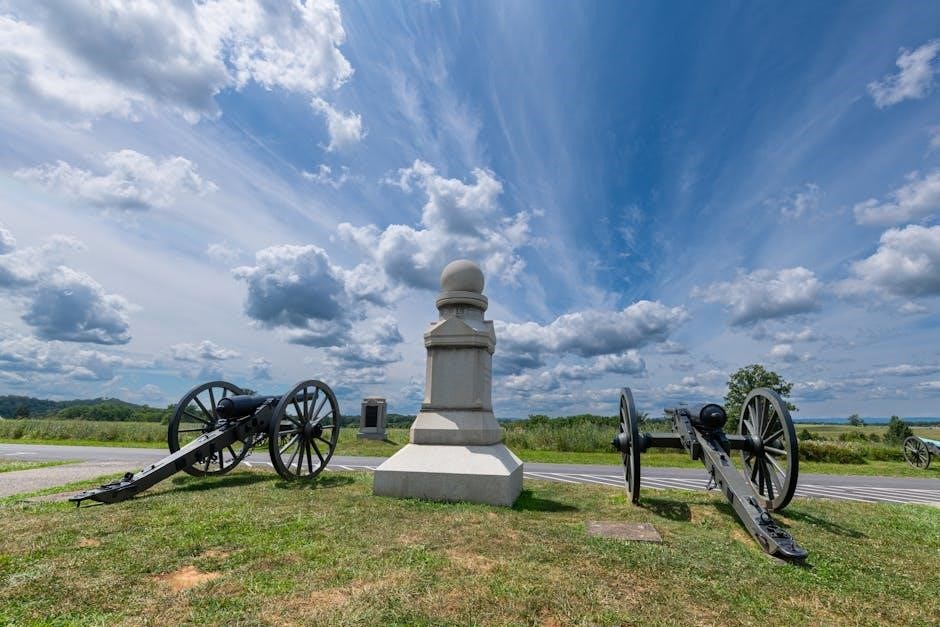
Researchers can access this primary source through online archives and digital libraries, preserving her firsthand observations. Foster’s narrative complements soldier accounts, offering a crucial understanding of the battle’s impact on the local community; The PDF format ensures accessibility for scholars and enthusiasts alike, allowing for detailed study of her recollections. It’s a powerful testament to the resilience of those who endured the siege of Gettysburg.
Tillie Pierce’s Account: A Seminary Girl’s Perspective
Tillie Pierce’s compelling narrative, penned as a young seminary student during the battle, offers a uniquely intimate and harrowing perspective. Her account, often found in digitized collections and PDF formats, details the disruption of her literary exercises and the ensuing terror as fighting engulfed Gettysburg. Pierce’s recollections vividly capture the fear and uncertainty experienced by civilians caught in the crossfire.
The transcription of her eyewitness testimony, combined with historical context, provides a powerful window into the battle’s impact on the town’s youth. Available online, her story resonates with readers, offering a deeply personal connection to the events of July 1863. It’s a crucial primary source for understanding the civilian experience during the Civil War, readily accessible in PDF form.

Richard Rollins’ “Battle of Gettysburg An Eyewitness Account”
Richard Rollins’ detailed account provides a comprehensive, firsthand perspective on the Battle of Gettysburg, frequently available as a downloadable PDF. His work meticulously documents the unfolding events, offering valuable insights into the strategic decisions and brutal realities faced by soldiers. Rollins’ narrative contributes significantly to understanding the fluidity of time experienced under intense stress, as evidenced by varying estimates of bombardment duration.
This account, often included in compilations of Civil War eyewitness testimonies, is a crucial primary source for researchers and enthusiasts. The PDF format allows for easy access and study of his observations, enriching our understanding of the battle’s complexities. Rollins’ work stands as a testament to the enduring power of personal narratives from the conflict.
Firsthand Accounts from Confederate Soldiers: Lee, Longstreet, & Pickett
Compilations of Civil War eyewitness accounts frequently include reports from Confederate leaders like Lee, Longstreet, and Pickett, often accessible in PDF format. These primary sources offer invaluable, though naturally biased, perspectives on the battle’s unfolding events and the strategic rationale behind their decisions. Examining their accounts alongside Union perspectives provides a more nuanced understanding of Gettysburg.
Specifically, accounts detailing Pickett’s Charge, a pivotal moment in the battle, are readily available. These PDFs reveal the immense courage and devastating losses experienced by Confederate soldiers. Accessing these firsthand narratives allows researchers to analyze the Confederate command structure and the human cost of the battle, enriching historical understanding.
Union Perspectives: Meade & Hancock’s Reports
Digitized collections of Civil War documents often contain official reports from Union commanders George Meade and Winfield Scott Hancock, frequently available as PDFs. These reports provide crucial insights into the Union army’s defensive strategies, troop movements, and assessments of the battlefield situation during and after Gettysburg. They detail the challenges faced in repelling Confederate assaults and securing victory.
Researchers can access these primary sources to analyze the Union leadership’s decision-making process and understand the logistical complexities of commanding a large army in battle. Examining these PDFs alongside eyewitness accounts from soldiers and civilians offers a comprehensive view of the battle, revealing the Union perspective on this pivotal moment in American history.

Analyzing Eyewitness Testimony: Challenges & Insights
PDFs of accounts reveal varying bombardment duration estimates, highlighting how stress impacts perception and memory; careful analysis distinguishes observation from later recollections.
The Fluidity of Time Under Stress: Varying Estimates of Bombardment Duration
Eyewitness accounts, readily available in digitized PDFs like those compiled from the Gettysburg Compiler and Richard Rollins’ work, demonstrate a fascinating phenomenon: the subjective distortion of time under extreme duress. Accounts of the bombardment preceding Pickett’s Charge, for example, vary widely in estimating its length. Some survivors recall hours of relentless shelling, while others perceive it as a comparatively brief, albeit terrifying, period.
This discrepancy isn’t due to deliberate falsehoods, but rather the psychological impact of intense fear and chaos. The brain, overwhelmed by sensory input and the instinct for survival, doesn’t accurately record temporal information. Consequently, recollections become fragmented and unreliable, leading to differing perceptions of the same event. Analyzing these variations within “I Survived” narratives provides valuable insight into the human experience of trauma and the challenges inherent in relying solely on eyewitness testimony.
Primary vs. Secondary Sources: Distinguishing Direct Observation
When researching the Battle of Gettysburg using “I Survived” PDFs and collections, discerning between primary and secondary sources is crucial. Primary sources – like Catherine Mary White Foster’s report initially published in the Gettysburg Compiler, or Tillie Pierce’s Seminary account – offer direct, firsthand observations from individuals present at the battle. These accounts, though subjective, provide unfiltered perspectives.
Conversely, secondary sources analyze and interpret these primary accounts. While valuable for context and analysis (like DS Hartwig’s work), they represent a step removed from the original event. Understanding this distinction is vital for accurate historical interpretation. PDF compilations often contain both, requiring careful evaluation of each source’s origin and intent to assess its reliability and potential biases when reconstructing the events of Gettysburg.
The Impact of the Battle on the Local Community
“I Survived the Battle of Gettysburg” PDFs reveal the profound impact on civilians. Accounts detail how Gettysburg’s residents experienced the battle’s immediate aftermath – tending to the wounded, dealing with immense loss, and confronting widespread destruction. The Gettysburg Compiler published numerous eyewitness accounts illustrating the community’s suffering and resilience.
These primary sources demonstrate the battle transformed homes into hospitals and fields into cemeteries. Beyond the military conflict, the civilian experience highlights the battle’s lasting trauma. Accessing these digitized narratives through online archives provides a crucial understanding of the human cost extending beyond soldiers, showcasing how Gettysburg’s identity was irrevocably altered by three days of intense fighting and its prolonged recovery.
Locating & Accessing “I Survived the Battle of Gettysburg” PDFs & Collections
Digital libraries and online archives host numerous “I Survived” accounts, including those initially published in the Gettysburg Compiler and compiled collections.
Online Archives & Digital Libraries
Numerous online resources provide access to digitized primary source materials relating to the Battle of Gettysburg, including invaluable “I Survived” accounts. Researchers can explore collections within digital libraries like the Library of Congress and university archives, often containing scanned PDFs of original documents.
Specifically, searching for publications of the Gettysburg Compiler – which previously printed Catherine Mary White Foster’s report – can yield fruitful results. Many historical societies also maintain online databases with transcribed eyewitness testimonies. These digital collections frequently include accounts from both Union and Confederate soldiers, offering diverse perspectives on the conflict.
Furthermore, projects dedicated to Civil War history often aggregate these resources, making them easily searchable. Accessing these archives allows for in-depth study of personal experiences during this pivotal battle, enriching our understanding beyond traditional historical narratives.
Published Compilations of Civil War Eyewitness Accounts
Beyond digital archives, numerous published compilations gather firsthand accounts of the Civil War, frequently including narratives from Gettysburg survivors. These books often curate a diverse range of perspectives, offering a comprehensive view of the battle’s impact. Collections featuring accounts from Lee, Longstreet, Pickett, Meade, and Hancock provide strategic insights alongside personal experiences.
Researchers seeking “I Survived” stories can find valuable resources in anthologies dedicated specifically to Gettysburg. These compilations often present transcribed letters, diaries, and memoirs, offering intimate details unavailable elsewhere.
While some may require physical access, many are now available as reprinted editions or digitized PDFs, expanding accessibility. These published works provide a curated and contextualized experience, complementing online archival research.

The Gettysburg Compiler & Local Historical Societies
The Gettysburg Compiler served as a crucial local source, initially publishing eyewitness accounts shortly after the battle’s conclusion. Catherine Mary White Foster’s report, for example, appeared in its pages on June 29th and July 6th, 1904, offering a contemporary perspective. Accessing archived issues, often available as digitized PDFs through libraries, unlocks these invaluable primary sources.
Local historical societies in Gettysburg maintain extensive collections of letters, diaries, and oral histories from residents who lived through the conflict. These organizations frequently possess unique “I Survived” narratives not widely available elsewhere.
Exploring their holdings, both physically and through online catalogs, can reveal previously unpublished accounts, enriching our understanding of the battle’s human cost.
Picketts Charge: Accounts from Participants
Richard Rollins’ “Battle of Gettysburg An Eyewitness Account” provides detailed perspectives on Pickett’s Charge, drawing from numerous participant recollections. Compilations of Civil War eyewitness accounts, often available as downloadable PDFs, include firsthand narratives from Confederate soldiers involved in this pivotal assault.
Accounts from Lee, Longstreet, and Pickett himself, featured in collections of primary sources, offer insights into the planning and execution of the charge, as well as the harrowing experiences of those who participated.
These PDFs frequently contain vivid descriptions of the bombardment and infantry advance, revealing the courage and desperation of the soldiers involved, and their struggles to survive.