
Moment of inertia is crucial for understanding rotational motion‚ with formulas varying by shape. Numerous PDF resources detail these calculations for cylinders‚ spheres‚ and rectangles.
What is Moment of Inertia?
Moment of inertia‚ also known as angular mass or rotational inertia‚ describes an object’s resistance to changes in its rotation. Unlike mass‚ which resists linear acceleration‚ moment of inertia opposes angular acceleration. It’s fundamentally dependent not only on an object’s mass but also on how that mass is distributed relative to the axis of rotation.
Calculating moment of inertia involves determining how difficult it is to start or stop an object spinning. This calculation differs significantly based on the object’s shape and the chosen axis. PDF documents readily available online provide detailed formulas for common shapes like solid cylinders‚ spheres‚ rods‚ and rings. These resources often include examples demonstrating how to apply the formulas.
For instance‚ a solid cylinder’s moment of inertia around its central axis is different than that of a thin ring. Understanding these distinctions is vital in fields like engineering and physics‚ where rotational dynamics are paramount. The distribution of mass dictates the value‚ making it a crucial concept for analyzing rotating systems.
Importance of Moment of Inertia Formulas
Moment of inertia formulas are essential for accurately predicting the behavior of rotating objects. They underpin calculations in diverse fields‚ from designing rotating machinery like engines and turbines to analyzing the stability of structures and the motion of celestial bodies.
Access to reliable formulas‚ often compiled in PDF guides‚ allows engineers and physicists to determine the torque required to achieve a desired angular acceleration. This is critical for efficient and safe design. Without these formulas‚ estimations would be inaccurate‚ potentially leading to system failures or suboptimal performance.
Furthermore‚ understanding moment of inertia is vital when applying theorems like the parallel axis theorem‚ which simplifies calculations for axes not passing through the center of mass. Numerous resources provide examples of these applications. Correctly applying these formulas ensures precise modeling of rotational dynamics‚ crucial for real-world applications and simulations.

Moment of Inertia Formulas for Basic Shapes
Basic shapes like cylinders‚ spheres‚ and rods have established moment of inertia formulas‚ often detailed in PDF guides‚ simplifying rotational dynamics calculations.
Moment of Inertia of a Point Mass
The moment of inertia for a single point mass represents the simplest case in rotational dynamics. It’s fundamentally defined as the product of the mass (m) and the square of its distance (r) from the axis of rotation. This relationship‚ expressed as I = mr²‚ is a cornerstone for calculating the inertia of more complex objects.
Understanding this basic principle is vital because complex shapes can often be conceptually broken down into a collection of point masses. Numerous PDF resources dedicated to moment of inertia formulas consistently highlight this foundational equation. These guides often illustrate how to apply this concept to systems with multiple point masses‚ summing the individual moments of inertia to find the total rotational inertia.
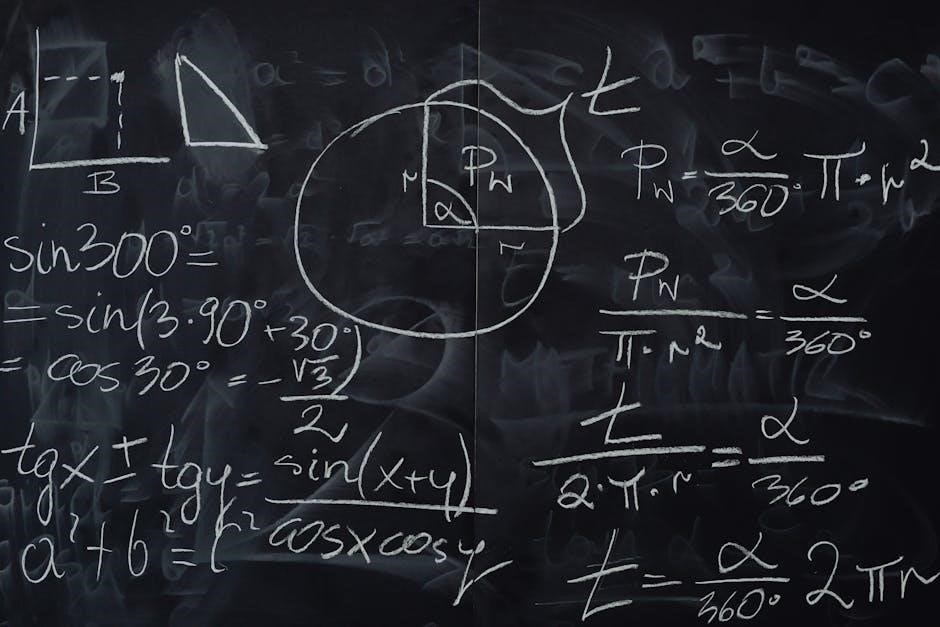
The distance ‘r’ is crucial; a larger distance significantly increases the moment of inertia‚ indicating greater resistance to changes in rotational speed. This concept is frequently demonstrated with examples in instructional materials available as PDF documents‚ showcasing practical applications in physics and engineering.
Moment of Inertia of a Rod
Calculating the moment of inertia of a rod depends critically on the axis of rotation. PDF resources detailing moment of inertia formulas consistently present two primary scenarios: rotation about the center and rotation about one end.
For a rod of length ‘L’ and mass ‘m’ rotating about its center‚ the formula is I = (1/12)mL². This indicates a lower resistance to rotational change compared to rotation about an end. Conversely‚ when rotating about one end‚ the formula becomes I = (1/3)mL²‚ demonstrating a significantly higher moment of inertia.
These formulas are frequently illustrated in educational PDF guides with diagrams and worked examples. Understanding the difference is crucial for accurately predicting a rod’s rotational behavior. Many resources emphasize the importance of correctly identifying the axis of rotation before applying the appropriate formula. These guides often include tables summarizing the formulas for various shapes‚ including rods.

Rod Rotating About its Center
When a rod‚ possessing mass ‘m’ and length ‘L’‚ rotates around its central axis‚ its moment of inertia is calculated as I = (1/12)mL². This formula is a cornerstone in rotational dynamics‚ frequently detailed in PDF guides on moment of inertia formulas.
The (1/12) factor arises from the distribution of mass relative to the rotation axis; mass closer to the center contributes less to the overall inertia. Numerous educational resources‚ often available as PDF documents‚ illustrate this concept with clear diagrams and step-by-step derivations.
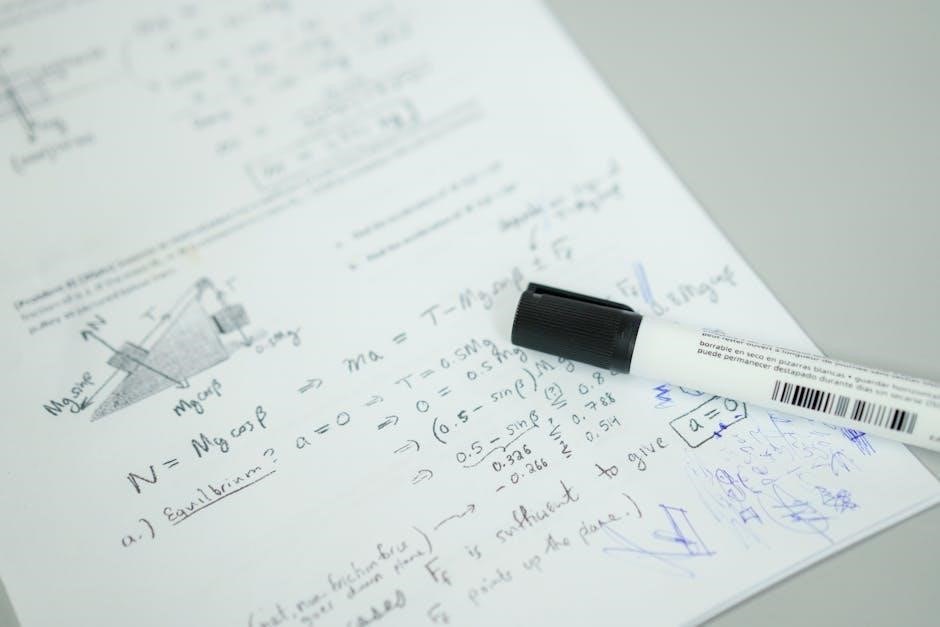
Understanding this formula is vital for analyzing systems involving rotating rods‚ such as balancing beams or simple pendulums. PDF examples often showcase applications in physics problems‚ emphasizing the importance of correct unit usage. The lower moment of inertia compared to rotation about an end makes it easier to initiate and change the rod’s rotational motion.
Rod Rotating About One End
Consider a uniform rod of mass ‘m’ and length ‘L’ rotating about an axis perpendicular to its length‚ passing through one end. The moment of inertia is then I = (1/3)mL². This differs significantly from rotation about the center‚ as detailed in many PDF resources on moment of inertia formulas.

The increased value (1/3 versus 1/12) reflects the greater average distance of the mass from the rotation axis; PDF guides often visually demonstrate this‚ showing how mass distribution impacts rotational resistance. This configuration requires more torque to achieve the same angular acceleration.
Practical applications include analyzing the motion of a pendulum or a swinging gate. Numerous PDF examples illustrate calculations for angular velocity and kinetic energy. Mastering this formula is crucial for solving rotational dynamics problems‚ and understanding why the end-rotation inertia is larger.
Moment of Inertia of a Solid Cylinder
The moment of inertia for a solid cylinder depends heavily on the axis of rotation. Numerous PDF documents detailing moment of inertia formulas showcase these variations. For a cylinder of mass ‘m’ and radius ‘r’‚ rotating about its central axis‚ the formula is I = (1/2)mr². This is a fundamental calculation in rotational mechanics.
However‚ when rotating about an axis through its center of mass‚ perpendicular to the cylinder’s length‚ the formula changes. PDF resources clearly illustrate this‚ providing I = (1/2)mr² + (1/4)mL²‚ where L is the cylinder’s height. The added term accounts for the mass distribution along the length.
Understanding these differences is vital for analyzing rotating machinery like flywheels or axles. Many PDF examples demonstrate applying these formulas to real-world engineering problems‚ emphasizing the importance of correctly identifying the rotation axis.
Cylinder Rotating About its Central Axis
When a solid cylinder‚ possessing mass ‘m’ and radius ‘r’‚ rotates around its central axis‚ its moment of inertia is a straightforward calculation. Numerous PDF guides on moment of inertia formulas consistently present this as I = (1/2)mr². This formula signifies the cylinder’s resistance to changes in rotational speed around that specific axis.
PDF resources often illustrate this with examples‚ showing how the mass distribution contributes to this value; The formula assumes a uniform density throughout the cylinder. Variations in density would necessitate more complex calculations‚ often detailed in advanced PDF materials.
This calculation is foundational in understanding rotating systems‚ like wheels or shafts. Many engineering PDF documents utilize this formula to analyze the dynamics of such systems‚ emphasizing its practical application. Correctly applying this formula is crucial for accurate modeling and prediction of rotational behavior.
Cylinder Rotating About an Axis Through its Center of Mass
Calculating the moment of inertia of a solid cylinder (mass ‘m’‚ radius ‘r’) rotating around an axis passing through its center of mass‚ but not the central axis‚ requires considering the mass distribution. PDF resources detailing moment of inertia formulas often present this as I = mr². This differs from rotation about the central axis (I = ½mr²).

The key difference lies in the distance of the mass from the rotation axis. PDF guides frequently explain this using the parallel axis theorem‚ which adds a term accounting for this distance. Understanding this distinction is vital for accurate calculations.
Engineering PDF documents demonstrate how this formula applies to real-world scenarios‚ like analyzing the stability of rotating machinery. Correctly applying this formula ensures accurate modeling of rotational dynamics‚ crucial for design and analysis. Numerous online PDFs provide step-by-step examples.
Moment of Inertia of a Solid Sphere
The moment of inertia for a solid sphere (mass ‘m’‚ radius ‘r’) rotating about an axis through its center is a fundamental calculation in rotational dynamics. PDF resources consistently state this formula as I = (2/5)mr². This value reflects the uniform mass distribution within the sphere and its distance from the rotational axis.
Many engineering PDF guides emphasize that this formula is derived using integral calculus‚ but readily available tables within these documents provide the result for practical application. Understanding this value is crucial for analyzing the rotational behavior of spherical objects.
Detailed PDFs often include examples demonstrating how to apply this formula to problems involving rolling spheres or gyroscopic motion. These resources highlight the importance of using the correct formula based on the axis of rotation. Several online PDFs offer worked examples for clarity.
Sphere Rotating About an Axis Through its Center
When a solid sphere‚ possessing mass ‘m’ and radius ‘r’‚ rotates around an axis directly through its center‚ its moment of inertia is defined by a specific‚ widely documented formula. Numerous PDF resources confirm this value as I = (2/5)mr². This formula is a cornerstone of rotational mechanics calculations.
Engineering handbooks‚ often available as PDF downloads‚ detail the derivation of this formula using integral calculus‚ though the final result is typically presented for direct use. These PDFs emphasize the importance of understanding the sphere’s uniform density in this calculation.
Practical applications‚ illustrated in many PDF examples‚ include analyzing the rotational energy of rolling spheres and the stability of rotating objects. Several PDF guides provide step-by-step solutions to problems involving this specific scenario‚ ensuring accurate application of the formula.
Moment of Inertia of a Ring
Calculating the moment of inertia for a ring – defined by its mass ‘m’ and radius ‘r’ – is fundamental in rotational dynamics. Standard formulas‚ readily available in engineering PDF documents‚ state that I = mr². This simplicity arises from the ring’s uniform mass distribution around its circular path.
Many PDF resources dedicated to mechanics showcase examples where this formula is applied‚ such as analyzing rotating flywheels or the stability of circular objects. These PDF guides often include diagrams illustrating the axis of rotation and the ring’s geometry.
Detailed derivations‚ found within comprehensive physics PDF textbooks‚ explain how integral calculus confirms this result. Practical PDF problem sets demonstrate how to apply this formula in conjunction with other rotational motion principles‚ solidifying understanding.

Moment of Inertia Formulas for Composite Shapes
For complex objects‚ utilize the Parallel Axis Theorem and Perpendicular Axis Theorem. PDF guides detail combining individual shape moments for accurate calculations.
Parallel Axis Theorem
The Parallel Axis Theorem provides a method to determine the moment of inertia of a rigid body about any axis‚ given its moment of inertia about a parallel axis through its center of mass. This is exceptionally useful when dealing with composite shapes or when the axis of rotation isn’t conveniently located at the center.
The theorem’s formula is: I = Icm + Md2‚ where ‘I’ is the moment of inertia about the new axis‚ ‘Icm‘ is the moment of inertia about the center of mass‚ ‘M’ is the mass of the object‚ and ‘d’ is the distance between the two parallel axes.
Numerous PDF resources and online materials demonstrate practical applications of this theorem. They often include examples showing how to calculate the moment of inertia of objects like rods and laminas. Understanding this theorem simplifies calculations for irregularly shaped bodies‚ allowing engineers and physicists to analyze rotational dynamics effectively. Several documents list examples of using this theorem with tables of moments of inertia.
Perpendicular Axis Theorem
The Perpendicular Axis Theorem is a powerful tool specifically applicable to calculating the moment of inertia of a planar lamina – a flat‚ two-dimensional object. It states that the moment of inertia about an axis perpendicular to the plane of the lamina is equal to the sum of the moments of inertia about two perpendicular axes lying in the plane and intersecting at the same point.
Mathematically‚ this is expressed as: Iz = Ix + Iy‚ where Iz is the moment of inertia about the perpendicular axis (z-axis)‚ and Ix and Iy are the moments of inertia about the two perpendicular axes (x and y) within the plane.
Many PDF documents detailing moment of inertia formulas showcase this theorem’s utility. These resources often provide examples for shapes like rectangles and triangles. It’s crucial to remember this theorem only applies to planar objects; it cannot be used for three-dimensional bodies. Understanding this theorem simplifies calculations significantly when dealing with flat shapes.

Formulas for Common Geometric Shapes
PDF guides offer readily available formulas for calculating moments of inertia of rectangles‚ triangles‚ circles‚ and ellipses‚ essential for diverse engineering applications.
Moment of Inertia of a Rectangle
Calculating the moment of inertia for a rectangle depends on the axis of rotation. PDF resources consistently present formulas for both axes – parallel to the length (b) and parallel to the width (h). When rotating about an axis through the centroid and parallel to the base (b)‚ the formula is (1/12) * m * (h3) + (1/12) * m * (b3)‚ where ‘m’ represents the mass of the rectangle.
Alternatively‚ if the rectangle rotates around an axis through its centroid parallel to the height (h)‚ the formula becomes (1/12) * m * (b3) + (1/12) * m * (h3). These formulas are frequently found within engineering handbooks and PDF guides detailing moment of inertia calculations. Understanding these distinctions is vital for accurate rotational dynamics analysis. Several online resources and downloadable PDF documents provide step-by-step examples‚ aiding in practical application of these formulas.
Moment of Inertia of a Triangle
Determining the moment of inertia of a triangle is more complex than for rectangles‚ heavily reliant on the chosen axis of rotation. PDF documents specializing in moment of inertia calculations typically detail formulas based on rotation about the centroid. For a triangle with base ‘b’ and height ‘h’‚ rotating about an axis through the centroid parallel to the base‚ the formula is (1/36) * m * (b2 + h2)‚ where ‘m’ is the mass.
However‚ rotation about other axes requires different formulas‚ often involving integration. Numerous PDF guides provide these derivations. It’s crucial to correctly identify the axis relative to the triangle’s geometry. Online resources and downloadable PDFs often present worked examples to illustrate these calculations. Accurate application of these formulas is essential for analyzing the rotational behavior of triangular structures‚ as detailed in engineering PDF handbooks.
Moment of Inertia of a Circle
Calculating the moment of inertia of a circle is a common task in physics and engineering‚ frequently detailed in PDF formula sheets. For a circle of mass ‘m’ and radius ‘r’‚ rotating about an axis perpendicular to its plane and through its center‚ the moment of inertia is (1/2) * m * r2. This fundamental formula appears consistently across various PDF resources.
However‚ if the axis of rotation isn’t through the center‚ the Parallel Axis Theorem must be applied‚ as explained in many engineering PDF guides. These documents provide step-by-step instructions. Numerous downloadable PDFs offer comprehensive tables of moment of inertia values for different shapes‚ including circles. Understanding these formulas is vital for analyzing rotating systems‚ and readily available PDFs simplify these calculations‚ offering practical examples and derivations.
Moment of Inertia of an Ellipse
Determining the moment of inertia for an ellipse is more complex than for a circle‚ and detailed formulas are readily available in engineering PDF resources. For an ellipse with semi-major axis ‘a’‚ semi-minor axis ‘b’‚ and mass ‘m’‚ rotating about an axis through its center‚ the moment of inertia is (1/2) * m * (a2 + b2). These formulas are frequently found within comprehensive PDF guides on rotational dynamics.
Many PDF documents emphasize that the orientation of the axes matters significantly. If the ellipse isn’t aligned with the coordinate axes‚ transformations are needed‚ as explained in advanced mechanics PDFs. Downloadable PDF tables often provide pre-calculated values for common configurations. Mastering these calculations‚ aided by accessible PDF materials‚ is crucial for analyzing systems with elliptical components‚ and understanding the impact of shape on rotational behavior.

Resources and Further Learning
PDF documents offer detailed moment of inertia formulas for various shapes. Online calculators simplify calculations‚ complementing the theoretical understanding gained from these resources.
PDF Resources for Moment of Inertia Formulas
Numerous PDF documents comprehensively catalog moment of inertia formulas for a wide array of geometric shapes. These resources are invaluable for students‚ engineers‚ and anyone needing a readily accessible reference. Documents often include formulas for basic shapes like rectangles‚ triangles‚ and circles‚ extending to more complex forms such as I-beams and composite structures.
Many PDF guides detail calculations for solid cylinders‚ spheres‚ and rings‚ specifying formulas for rotation about different axes – central axes‚ axes through the center of mass‚ and parallel axes. Some resources‚ exceeding 75 pages‚ provide extensive examples demonstrating the application of the parallel axis theorem and detailed tables for quick look-up of moments of inertia. These documents frequently offer step-by-step solutions‚ aiding in understanding the underlying principles.
A 3-page PDF specifically focuses on moment of inertia formulas‚ while others present calculations and examples. These readily available resources are often rated highly‚ achieving a 5.0/5.0 score‚ indicating their clarity and usefulness. They are essential tools for mastering rotational dynamics and related engineering applications.
Online Calculators for Moment of Inertia
While PDF resources provide formulas‚ numerous online calculators simplify moment of inertia calculations. These tools are particularly useful for complex shapes or when quick results are needed‚ eliminating manual computation and potential errors. Many calculators allow users to input geometric parameters – dimensions‚ mass‚ and axis of rotation – to instantly determine the moment of inertia.
These online tools often support a variety of standard shapes‚ including rectangles‚ circles‚ triangles‚ and cylinders. Some advanced calculators even handle composite shapes‚ utilizing the parallel axis theorem automatically. They can be invaluable for verifying hand calculations or for iterative design processes.
Although the provided text doesn’t directly mention specific calculator websites‚ the need for efficient calculation is evident. Complementing PDF formula guides‚ these calculators offer a practical application of theoretical knowledge. Remember that understanding the underlying formulas‚ as detailed in PDF documents‚ remains crucial for interpreting results and ensuring accuracy.